How to Beat Jet Lag and Stay Energised
Explore strategies to minimise jet lag, boost energy, and enhance sleep with AVEA Sereniser so travel remains enjoyable and fatigue-free.
---
url: https://insights.avea-life.com/better-sleep/beating-jet-lag-and-staying-energised-this-summer/
title: How to Beat Jet Lag and Stay Energised
scraped_at: 2025-11-30
type: wordpress
---
# Beating Jet Lag and Staying Energised This Summer
Written by [Sophie Chabloz](https://insights.avea-life.com/author/sophie-chabloz/)
Summer is the season of sunshine, exploration, and travel, but if you’re crossing time zones, you might run into one major hurdle: jet lag. Whether you’re chasing sunsets in Europe or trekking through Southeast Asia, understanding jet lag and how to recover from it, can make or break your travel experience.
Understanding what jet lag is, why it happens, and how to combat it effectively will help you travel better and recover faster. Plus, we’ll introduce [AVEA Sereniser](https://avea-life.com/products/sereniser) science-backed supplement to help you stay rested and energised all summer long.
## **What Is Jet Lag?**
Jet lag is a circadian rhythm sleep disorder that occurs when your internal body clock is misaligned with the time zone of your destination. Your body is programmed to follow a 24-hour cycle based on your local environment, mainly light and darkness. When you cross multiple time zones quickly, your body’s clock struggles to keep up, leading to fatigue and other disruptive symptoms.
Jet lag is especially common when flying eastward (e.g., from New York to Paris) because it shortens the day, making it harder to fall asleep earlier than your usual time.
## **Symptoms of Jet Lag**
Jet lag symptoms are the result of your body being out of sync with the local time. They can affect both mental and physical performance, and tend to vary based on the number of time zones crossed, direction of travel, and individual sensitivity.
### **Common Symptoms Include:**
- **Fatigue and Daytime Sleepiness:** despite getting some sleep on the plane, you might feel sluggish or exhausted during the day because your internal clock thinks it’s nighttime.
- **Insomnia or Poor-Quality Sleep:** you may find it hard to fall asleep at the right local time or wake up too early. Even if you sleep, it may not feel restorative.
- **Cognitive Impairment:** difficulty focusing, forgetfulness, and slower reaction times are common when your body clock is disrupted.
- **Mood Changes:** jet lag often causes irritability, mild depression, or anxiety due to poor sleep and physical stress.
- **Digestive Problems:** your digestion is also on a circadian rhythm, so nausea, constipation, or loss of appetite can occur while your gut adjusts.
## **Causes of Jet Lag**
Jet lag happens because your circadian rhythm, the body’s internal 24-hour clock, becomes misaligned with the day-night cycle of your destination. Your body continues to produce hormones like melatonin and cortisol based on the time at home, not where you’ve landed.

### **Main Causes:**
- **Crossing Multiple Time Zones Quickly:** Traveling by plane across three or more time zones doesn’t give your internal clock enough time to adjust gradually.
- **Lack of Natural Light Exposure:** Sunlight is a major cue for regulating your body clock. Limited natural light exposure during travel can delay your adjustment.
- **Poor Sleep Before or During the Flight:** Travel stress, uncomfortable seating, and flight timing can disrupt your rest, worsening symptoms once you land.
- **Dehydration and Inflammation:** Cabin pressure and dry air contribute to dehydration and inflammation, both of which hinder recovery and reduce energy levels.
## **Tips for Beating Jet Lag**
You can’t completely avoid jet lag, but with the right strategies, you can minimize its effects and recover faster. Here’s how to support your mind and body:
### **1\. Shift Your Schedule in Advance**
Start adjusting your sleep and meal times a few days before your trip to match your destination’s time zone. Shifting your bedtime and wake-up time by 30–60 minutes earlier (for eastward travel) or later (for westward travel) each day helps smooth the transition. Adjusting meal timing alongside sleep cues can further reinforce the shift in your internal clock.
### **2\. Get Strategic Natural Light Exposure**
Light is the most powerful external cue for regulating your circadian rhythm. When travelling east, seek bright morning light to help your body shift earlier; when going west, aim for late afternoon or evening light to delay your rhythm. Spend time outdoors if possible—natural light is significantly more effective than artificial lighting. In the evening, reduce exposure to blue light from screens to allow melatonin to rise naturally and prepare your body for sleep.
### **3\. Take AVEA Sereniser, non-sedative and melatonin-free sleep support supplement**
### **Why Melatonin Isn’t Always the Best Fix**
Melatonin supplements are a common go-to for jet lag, but they don’t always deliver lasting results. Taking external melatonin can override your body’s natural production, potentially making it harder to regulate your circadian rhythm long-term.
Dosage and timing are also critical—and often mishandled. Studies have found that many over-the-counter melatonin products contain much higher amounts than listed on the label, sometimes by several hundred percent. This increases the risk of side effects like grogginess, vivid dreams, or next-day sluggishness.
Instead of relying on a hormone, it’s often more effective to support the systems that _produce melatonin naturally_, especially when adjusting to a new time zone.
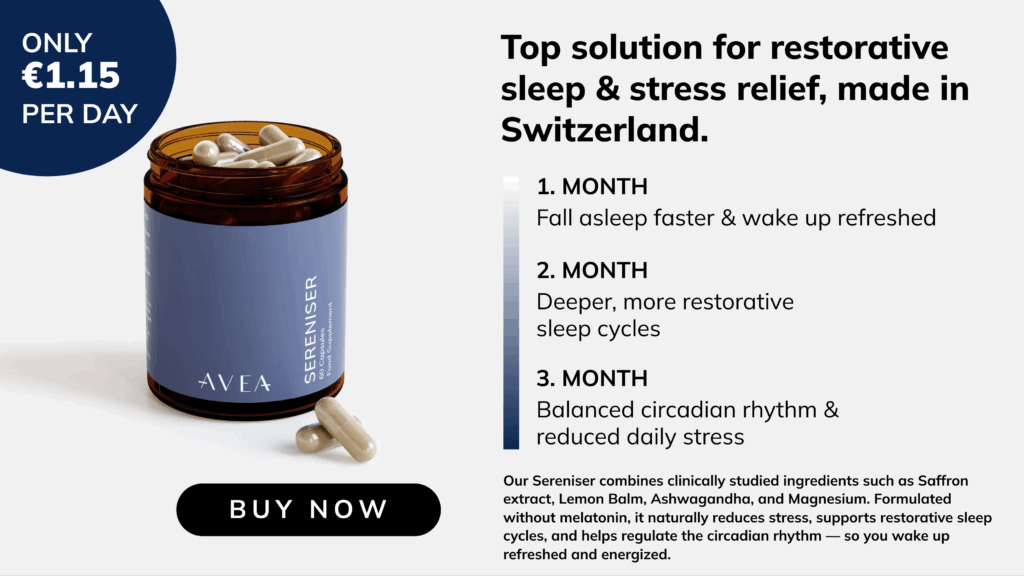
Hence, at AVEA, we’ve created AVEA [Sereniser](http://www.avea-life.com/products/sereniser?sub_id=google) is a non-sedative, melatonin-free sleep support supplement designed to help you fall asleep more easily, stay asleep longer, and wake up refreshed.
Instead of sedating you or simply flooding the body with melatonin, [Sereniser](http://www.avea-life.com/products/sereniser?sub_id=google) works with your biology—supporting the neurochemical and hormonal systems that govern high-quality, uninterrupted sleep.
The [Sereniser](http://www.avea-life.com/products/sereniser?sub_id=google) combines 3 highly effective plant extracts with magnesium and vitamin B6 for deep and uninterrupted sleep in one innovative formula:
**• Safr’Inside™ (Standardised saffron extract)**
Safr’Inside™ is a clinically studied, standardised extract of natural saffron designed for high bioavailability and consistent efficacy. It calms the body and mind to fall asleep faster, clinically shown to ease anxious thoughts, and regulate the serotonin–melatonin pathway. Saffron supplementation can reduce sleep onset latency, enhance sleep quality, and increase sleep duration. These effects are attributed to saffron’s influence on neurotransmitters and its potential to increase melatonin levels naturally, thereby supporting more restful and restorative sleep.
This makes it especially useful during jetlag, when melatonin rhythms are out of sync. By encouraging the body’s own melatonin production—without resorting to synthetic, external melatonin—it helps reset the sleep–wake cycle more gently and sustainably.
**• Holixer® (Holy basil extract, Ocimum tenuiflorum)**
A clinically studied plant extract that supports stress resilience and sleep quality. It helps stabilize cortisol fluctuations, reinforcing a consistent sleep-wake cycle. In recent trials, Holixer®—at a daily dose of 250 mg—was shown to reduce perceived stress, improve markers of parasympathetic activation, and enhance sleep quality over 8 weeks. These results suggest Holixer® helps quiet nighttime overactivity and support a smoother transition into deeper, more stable rest.
This cortisol-regulating effect is particularly relevant for jetlag, where elevated stress hormones and inconsistent circadian cues often impair sleep onset and depth. Additionally, Holy Basil has demonstrated immune-modulating properties, which may support immune resilience during travel-related stress.
**• Serezin™ (Standardised ginger and boswellia extract)**
A synergistic blend of frankincense (Boswellia serrata) (frankincense) and Ginger (Zingiber officinale) (ginger) extracts. Trademarked under the name SerezinTM, this plant extract has been clinically shown to enhance restorative sleep. It regulates inflammation and nighttime discomfort, reducing the chances of being woken up by any discomfort. In a 4-week study involving adults aged 50–70 with self-reported sleep disturbances due to everyday aches and pains, participants experienced significant improvements in sleep quality, reduced nighttime discomfort, and easier morning awakenings. Notably, by Day 14, subjects reported 93% better sleep quality and 2x easier morning waking compared to placebo.
For travellers, this is especially beneficial after long flights, when physical tension, joint stiffness or systemic inflammation can interfere with deep sleep in a new time zone.
**• Magnesium Bisglycinate + Vitamin B6**
This form of Magnesium is highly bioavailable and gentle on digestion. Magnesium bisglycinate helps relax muscles and regulate the nervous system. Paired with vitamin B6—a cofactor in GABA and serotonin synthesis—this duo supports both deep sleep and REM continuity.
During jetlag, when the nervous system is often overstimulated and serotonin pathways disrupted, this combination helps calm the body and re-establish normal sleep architecture aligned with the new local time.
Each ingredient is chosen not for a quick fix, but to work across the full sleep cycle—gently resetting the systems that govern real, restorative rest.
### **4\. Stay Hydrated and Eat Light**
Drink plenty of water before, during, and after your flight to stay energised and support your body’s natural detox processes. To go one step further, consider adding electrolytes—especially sodium, potassium, and magnesium—to help maintain fluid balance and reduce post-flight fatigue.
Avoid heavy meals, alcohol, and excess caffeine, which can interfere with sleep and digestion. Some research also suggests that fasting during the flight and eating your first full meal in sync with your destination’s local time may help reset your internal clock more effectively—using food as a secondary time cue alongside light exposure.
### **5\. Be Active After Arrival**
Gentle movement shortly after landing—like walking, stretching, or light mobility work—helps reset your body clock by boosting circulation, exposing you to daylight, and relieving stiffness from long travel. Light activity also promotes lymphatic flow, supporting natural detox after flying.
A short session that gets you lightly sweating can ease fatigue and help you sleep better later. If you arrive in the morning or need to stay awake, a cold shower can support alertness and energise your nervous system. If you’re preparing for sleep, opt for a warm shower or bath instead to promote relaxation and signal wind-down.
### **Conclusion**
**Restoring Your Rhythm—While Travelling and at Home**
Jet lag might make the need for quality sleep obvious—but in truth, many of us struggle with sleep even without crossing time zones. Stress, screen time, irregular schedules, and overstimulation all disrupt the same neurochemical systems that govern deep, restorative rest. **[AVEA Sereniser](https://avea-life.com/products/sereniser)** isn’t just a travel aid—it’s a daily tool to help your body unwind, rebalance, and reset your sleep cycle naturally. Whether you’re adapting to a new time zone or simply trying to get better sleep at home, [Sereniser](https://avea-life.com/products/sereniser) supports the full architecture of real rest—without sedatives, and without relying on synthetic melatonin.
[](https://avea-life.com/products/sereniser)
By [Sophie Chabloz](https://insights.avea-life.com/author/sophie-chabloz/)
Sophie is the co-founder and Chief Science Officer at Avea, focusing on developing innovative supplements with an emphasis on ingredient synergies. She holds an MSc in Food Science, Nutrition & Health from ETH Zurich, underpinning her strong scientific and industry expertise.